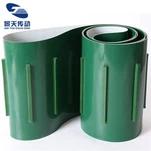
1. Direct Assessment Based on Operating Status
After starting the conveying equipment, if the conveyor belt frequently slips or spins idly-a phenomenon that becomes even more pronounced under load-and if issues such as dirty or worn rollers have been ruled out, it can generally be concluded that the tension is insufficient and requires re-tensioning.
If the conveyor belt frequently drifts off-center, and continues to drift again shortly after being realigned, this may be caused by uneven tension on one side or overall loose tension; re-tensioning adjustments are required.
During no-load operation, if the sag in the return section of the conveyor belt is excessive-specifically, if the sag exceeds 2% of the distance between two adjacent idlers-it indicates insufficient tension, and re-tensioning is required.
2. Manual Press Test (A Simple and Quick Method)
Manually press down vertically on the center of the conveyor belt:
If the belt depresses by more than 5 mm and rebounds slowly after you release it, it indicates that the tension is loose and requires re-tensioning.
If the belt depresses between 3–5 mm and rebounds smoothly, it indicates that the tension is appropriate.
If the belt depresses by less than 3 mm and feels difficult to press down, it indicates that the tension is excessive; it should be loosened slightly to avoid accelerated wear caused by over-tensioning.
3. Precise Assessment Using Measurement Tools
Use a tension meter to directly measure the conveyor belt's tension. If the actual tension has dropped by more than 15% compared to the initial installation tension, re-tensioning is required to restore the tension to the recommended range.
Measure the total length of the conveyor belt. If the elongation (stretching) exceeds 2% of the original length, it indicates that the belt body has stretched and loosened; re-tensioning is required to compensate for this elongation.
Special Note
After a PVC conveyor belt has been installed and operated for 1–2 weeks, it typically undergoes slight stretching and loosening. It is recommended to perform periodic re-checks during the initial operational period and make proactive tension adjustments to prevent the accumulation of slippage issues from negatively impacting production.