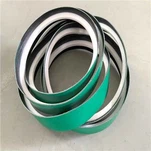
The paper industry and printing industry generally use sheet base belts, perforated conveyor belts, and pvc conveyor belts, etc.
Base belt: The base belt is a flat high-speed transmission belt. Usually, there is a nylon base layer in the middle of the base belt, and the surface is covered with rubber, cowhide, and fiber cloth; it is divided into rubber nylon base belt and cowhide nylon base belt. The strip thickness is usually in the range of 0.8-6mm. The material structure of the nylon sheet base belt is innovative and unique. Compared with the traditional canvas transmission belt and V-belt, it has the advantages of strong tensile force, flex resistance, high efficiency, low noise, fatigue resistance, good wear resistance, and long service life. Product use: suitable for occasions with compact transmission mechanism, high line speed and large speed ratio. Such as: cigarettes, cigarette machines, papermaking, printing, textile machinery, HVAC equipment, metal equipment, automatic vending equipment and military industry and other industries. It is also used for substrate lines, SMT equipment, and circuit board transportation in the electronics industry.
Perforated conveyor belt: refers to the high-precision perforation on the steel belt by a special process. It can be used in synchronous conveying, positioning conveying, (vacuum) adsorption conveying, etc. Mainly include: positioning conveyor belt, synchronous conveyor belt, (vacuum) adsorption conveyor belt, drying leakage conveyor belt, vegetable dehydration conveyor belt, forming conveyor belt.
PVC conveyor belt: PVC is actually a vinyl polymer, and its material is a non-crystalline material. PVC materials are often added with stabilizers, lubricants, auxiliary processing agents, colorants, impact agents and other additives in actual use. It has non-flammability, high strength, resistance to climate change and excellent geometric stability. PVC has strong resistance to oxidizing agents, reducing agents and strong acids. However, it can be corroded by concentrated oxidizing acids such as concentrated sulfuric acid and concentrated nitric acid, and it is not suitable for contact with aromatic hydrocarbons and chlorinated hydrocarbons.