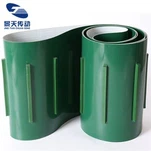
Conveyor belt: It is the leading component of belt conveyors, etc. It has a wide range of uses. The large ones are transported from the field of ore mining, to the light-weight items in the precision machinery. It can be said that the conveyor belt can be seen everywhere.
As one of the transportation methods, the conveyor belt can be widely used in various fields of the industry mainly because it is simpler than other similar transportation methods, and it is very economical, which can greatly reduce transportation costs and maintenance costs.
㈡Development history
①Conveyor belt has a long history in the world industry as a continuous transportation method of powdery materials (including granular and block) and a single transportation method of solid objects.
②As early as 1795: The United States formally proposed the concept of conveyor belts or conveyor belts, and applied for a patent in 1858. 1933: Britain standardized it for the first time. 1940s: Due to the rapid development of synthetic fibers, synthetic rubbers and resins and their application in the conveyor belt industry, the appearance of conveyor belt products has undergone epoch-making changes, fully demonstrating the functionality and economic vitality of conveyor belts. The 1960s: It can be said that it was the fastest growing period of conveyor belts in the world. The modernization of mining in the United States, Europe, Japan and other industrialized countries, the rapid development of steel, coal and chemical industries caused a sharp increase in the demand for conveyor belts. Conveyor belt industry.
③The development of conveyor belts in the world has generally gone through four periods.
a. The first period: the initial development period of the conveyor belt. From the second half of the 19th century to the mid-20th century, the main materials were natural rubber and cotton canvas. The production process adopts multiple pasting and segmented vulcanization methods. In use, multi-drive lining pulleys are used as a means to improve transportation capacity and long-distance transportation.
b. The second period: around 1970s, a period of great development of conveyor belts, which is characterized by a large number of main materials from natural rubber and cotton canvas to synthetic rubber, chemical fiber canvas and steel wire rope.
In terms of technology, the method of multi-layer one-time molding and flat-plate continuous vulcanization is used, and large-scale transportation and long-distance transportation have been realized in use, and the function has been achieved.
c. The third period: the period of conveyor belt technology reform. Its characteristics are the longer life and efficiency of the conveyor belt, the use of materials has been expanded from synthetic rubber to thermoplastic, and the conveyor belt has begun to achieve lighter weight.
At the same time, multifunctional conveyor belts, such as heat-resistant, oil-resistant, flame-resistant, acid- and alkali-resistant, abrasion-resistant, impact-resistant, and sliding-resistant conveyor belts have been further developed.
d. The fourth period: beginning in the 1990s, the conveyor belt entered a new period of integral molding, no vulcanization, the use of thermoplastic elastomers, aramid, and non-woven fabrics to simplify the structure and process, and emphasize environmental protection.