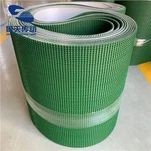
⑴Frame material: It provides the main tensile properties for the conveyor belt, and plays an important role in transmitting power, conveying materials, resisting impact, and maintaining the running track of the conveyor belt. Therefore, the performance of the framework material is the key factor that determines the performance, working life and processing method of the conveyor belt.
⑵Structure and performance of fiber materials
①The fibers used for the frame material of the conveyor belt usually include cotton, vinylon, nylon, polyester, aramid, glass fiber, etc.
Cotton: As the oldest tensile layer material, it is characterized by low strength, poor chemical resistance, heat resistance, impact resistance, and greater moisture absorption. However, cotton canvas has small elongation under load and good adhesion with rubber. It is not widely used now, and is gradually replaced by polyester and nylon, or blended with it.
②After being dipped, nylon and polyester, which are frequently used at present, have good adhesion properties like rubber. Polyamide has higher strength, but lower modulus, greater elongation in use, and easy deformation. The strength of polyester is similar to that of nylon, and the modulus is higher, and the dimensional stability is better. Therefore, light conveyor belts and flat conveyor belts are mostly interwoven with polyester to keep the warp dimension stable, and the weft direction is convenient for groove formation and elasticity.
⑶Metal tensile material
The steel wire rope used for the conveyor belt: made of high-grade carbon steel, the basic unit is steel wire, the diameter of the steel wire is 012~110mm, the steel wire is twisted into strands, and the multiple strands are arranged in a spiral to twist into a rope. The structure of the rope is mostly 7 strands, the rope diameter is 210~1410mm, the tensile strength is 1800~2600MPa, and the surface is galvanized to prevent rust.