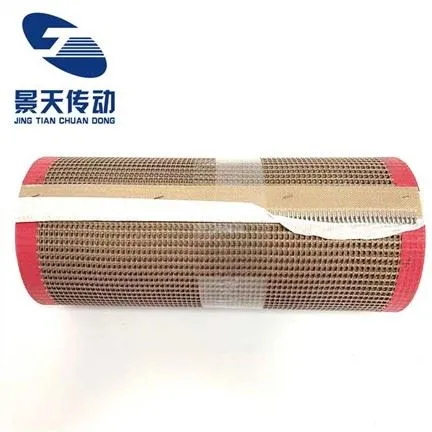
Silicon conveyor belts are widely used in various industrial applications due to their excellent physical and chemical properties. One of the most important properties of a silicon conveyor belt is its heat transfer characteristic. Understanding this property is crucial for optimizing the performance of conveyor systems, especially in applications where temperature control is vital. In this blog post, I'll delve into the heat transfer property of silicon conveyor belts, drawing on my experience as a silicon conveyor belt supplier.
The Basics of Heat Transfer
Before we explore the heat transfer properties of silicon conveyor belts, it's essential to understand the fundamental principles of heat transfer. There are three primary mechanisms of heat transfer: conduction, convection, and radiation.
Conduction is the transfer of heat through a material without any movement of the material itself. It occurs when there is a temperature gradient within the material, and heat energy flows from the higher - temperature region to the lower - temperature region. The rate of heat conduction is governed by Fourier's law, which states that the heat flux (q) is proportional to the temperature gradient (dT/dx) and the thermal conductivity (k) of the material: (q=-k\frac{dT}{dx})
Convection involves the transfer of heat by the movement of a fluid (liquid or gas). When a fluid comes into contact with a surface at a different temperature, heat is transferred between the surface and the fluid. There are two types of convection: natural convection, which is driven by density differences due to temperature variations, and forced convection, which is caused by an external force such as a fan or a pump.
Radiation is the transfer of heat in the form of electromagnetic waves. All objects emit thermal radiation, and the amount of radiation emitted depends on the object's temperature and emissivity.
Heat Transfer Properties of Silicon Conveyor Belts
Thermal Conductivity
Silicon is a polymer material with a relatively low thermal conductivity compared to metals. The thermal conductivity of silicon rubber typically ranges from 0.1 - 0.3 W/(m·K). This low thermal conductivity makes silicon conveyor belts good insulators, which can be an advantage in some applications.
For example, in food processing, where maintaining a specific temperature of the conveyed product is critical, the low thermal conductivity of the silicon conveyor belt helps prevent heat transfer between the belt and the product. This is beneficial when transporting sensitive food items that need to be kept at a particular temperature, such as chilled desserts or warm baked goods.
On the other hand, in applications where rapid heat transfer is required, the low thermal conductivity can be a limitation. However, some manufacturers, including us, have developed special silicon formulations with enhanced thermal conductivity by adding thermally conductive fillers such as aluminum oxide or boron nitride. These fillers can increase the thermal conductivity of the silicon conveyor belt to values up to 1 - 2 W/(m·K), depending on the filler type and loading.
Heat Resistance
Silicon conveyor belts have excellent heat resistance properties. They can withstand a wide range of temperatures, typically from - 60°C to 230°C, and in some cases, even higher temperatures for short periods. This high - temperature resistance makes them suitable for applications in industries such as baking, glass manufacturing, and electronics.
In the baking industry, silicon conveyor belts can operate in ovens at high temperatures without deforming or losing their mechanical properties. They can transport baked goods through the oven while maintaining their shape and functionality, ensuring a consistent baking process.
In electronics manufacturing, silicon conveyor belts are used to transport printed circuit boards (PCBs) through reflow ovens, where the PCBs are heated to melt the solder and attach components. The heat resistance of the silicon conveyor belt allows it to withstand the high temperatures required for the soldering process without damage.
Heat Transfer in Conveyor Belt Systems
In a conveyor belt system, heat transfer occurs through a combination of conduction, convection, and radiation. When the conveyor belt is in contact with a heated or cooled surface, conduction plays a significant role in heat transfer. For example, if the belt is running over a heated roller, heat is transferred from the roller to the belt through conduction.
Convection also affects heat transfer in conveyor belt systems. As the conveyor belt moves through the air, there is a convective heat transfer between the belt surface and the surrounding air. The rate of convective heat transfer depends on factors such as the air velocity, the temperature difference between the belt and the air, and the surface area of the belt.
Radiation heat transfer occurs when the conveyor belt exchanges heat with its surroundings in the form of electromagnetic waves. For instance, if the belt is operating in a high - temperature environment, it will radiate heat to the cooler surrounding objects.
Factors Affecting Heat Transfer in Silicon Conveyor Belts
Belt Thickness
The thickness of the silicon conveyor belt has a significant impact on its heat transfer properties. A thicker belt will have a lower rate of heat transfer compared to a thinner belt because the heat has to travel a longer distance through the material. In applications where rapid heat transfer is required, a thinner belt may be preferred. However, a thinner belt may have lower mechanical strength, so a balance needs to be struck between heat transfer and mechanical performance.
Belt Speed
The speed of the conveyor belt also affects heat transfer. A faster - moving belt spends less time in contact with a heat source or sink, resulting in less heat transfer. Conversely, a slower - moving belt allows more time for heat transfer to occur. In some applications, the belt speed may need to be adjusted to achieve the desired heat transfer rate.
Surface Finish
The surface finish of the silicon conveyor belt can influence heat transfer. A smooth surface has less contact resistance, which can enhance conduction heat transfer. Additionally, a smooth surface may reduce the drag force when the belt is moving through the air, which can affect convective heat transfer.
Applications Based on Heat Transfer Properties
High - Temperature Applications
As mentioned earlier, silicon conveyor belts are widely used in high - temperature applications. In the glass industry, they are used to transport hot glass products from one processing stage to another. The heat resistance and low thermal conductivity of the silicon conveyor belt prevent the glass from sticking to the belt and help maintain the temperature of the glass during transportation.
In the automotive industry, silicon conveyor belts are used in paint - curing ovens. They can withstand the high temperatures required for the paint - curing process and ensure the smooth transportation of car parts through the oven.
Low - Temperature Applications
Silicon conveyor belts are also suitable for low - temperature applications. In the cold storage and food freezing industries, they can transport frozen products without becoming brittle or losing their flexibility. The low thermal conductivity of the belt helps to minimize heat transfer from the surrounding environment to the frozen products, maintaining their low temperature.
Why Choose Our Silicon Conveyor Belts?
As a supplier of silicon conveyor belts, we offer a wide range of products with excellent heat transfer properties. Our belts are made from high - quality silicon materials that are carefully formulated to meet the specific requirements of different applications.
We have a team of experienced engineers who can provide customized solutions based on your heat transfer needs. Whether you need a belt with enhanced thermal conductivity for rapid heat transfer or a belt with high heat resistance for high - temperature applications, we can develop a product that suits your needs.
Our manufacturing process is严格 controlled to ensure the consistency and quality of our products. We conduct rigorous quality tests on each belt to ensure that it meets the highest standards of performance and reliability.
If you are looking for a reliable silicon conveyor belt supplier with a focus on heat transfer properties, we are here to help. Our expertise in silicon materials and conveyor belt technology allows us to provide you with the best solutions for your industrial applications.
Conclusion
The heat transfer property of silicon conveyor belts is a complex but important aspect that affects their performance in various industrial applications. Understanding the mechanisms of heat transfer, the factors that influence heat transfer, and the applications based on these properties is crucial for selecting the right conveyor belt for your needs.
As a silicon conveyor belt supplier, we are committed to providing high - quality products with excellent heat transfer properties. We encourage you to reach out to us to discuss your specific requirements and explore how our silicon conveyor belts can optimize your conveyor system's performance. Contact us today to start a procurement discussion and find the perfect solution for your business.
References
- Incropera, F. P., & DeWitt, D. P. (2002). Fundamentals of Heat and Mass Transfer. John Wiley & Sons.
- Cengel, Y. A. (2003). Heat Transfer: A Practical Approach. McGraw - Hill.
- "Silicone Rubber Properties and Applications" - A technical publication by a leading silicone material manufacturer.