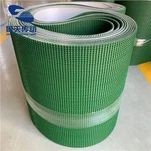
Customized non-standard PU conveyor belts are designed to overcome the limitations of standard belts, which only meet basic horizontal transport needs. Food processing production lines involve complex environments that require non-standard customization-such as incline climbing, spill prevention, vacuum adsorption, and precision conveying-to perfectly match equipment operating conditions. High-quality food-grade conveyor belt manufacturers provide one-stop PU conveyor belt customization services, utilizing non-slip processing, perforations, cleats, sidewalls, guide strips, and seamless splicing to resolve sorting slippage, material leakage, mistracking, and jamming. Below is a detailed guide to the mainstream customization techniques and their applications.
I. Mainstream Customization Techniques for Food-Grade PU Belts
1. Non-Slip Patterning
Purpose: Solves food slippage during incline conveying or when handling lightweight materials.
Options: Matte finishes, longitudinal ribs, diamond patterns, and grid patterns.
Applications: Incline lifting of fruits, vegetables, bagged snacks, and pastries. It increases surface friction, prevents slipping without damaging the product surface, and fully complies with food hygiene standards.
2. Corrugated Sidewalls & Cleats
Purpose: Prevents granular food, crumbs, and small fresh food items from falling or leaking.
Options: Food-grade corrugated sidewalls on both edges and vertical cleats across the center.
Applications: Food lifters, feeding machines, and vertical conveyor systems. The attachments are integrated seamlessly with the belt body, ensuring durability and easy cleaning.
3. Precision Perforations (Vacuum Adsorption)
Purpose: Allows uniform airflow and stable vacuum suction without retaining impurities, fulfilling clean production requirements.
Options: CNC punching of round holes, elongated slots, or matrix arrays with smooth, burr-free, and crack-resistant edges.
Applications: Air-suction sorting systems, packaging adsorption lines, and fruit/vegetable dehydration conveyors.
4. Tracking Guide Strips
Purpose: Eradicates left/right belt mistracking, edge wear, and friction damage during high-speed operations to reduce maintenance downtime.
Options: Food-grade V-guides/guide strips welded on the underside of the belt to precisely track roller grooves.
Applications: High-speed automation lines and long-distance conveyors prone to tracking issues.
5. Seamless Hot-Melt Splicing
Purpose: Elimination of joints, ridges, and dead zones where food particles or bacteria could accumulate, making sanitation fast and thorough.
Options: High-temperature vulcanized hot-melt technology for an integrated, single-piece belt joint.
Applications: High-speed continuous food production lines with strict hygiene and cleaning requirements.
6. Special Functional Customizations
Purpose: Meets specific extreme or highly regulated operating conditions.
Options: Anti-static treatments, flame retardancy, extra-thick wear resistance, and low-temperature cold-chain specifications.
Applications: Cold-chain food processing, precision food packaging, and explosion-proof production facilities.
II. The Customization Workflow
Requirement Analysis: The customer provides equipment parameters, used belt samples, or production environment details.
Technical Calculation: The manufacturer calculates precise dimensions and specifies matching fabrication techniques.
Proposal & Quote: A dedicated, custom configuration plan and quotation are issued.
Precision Manufacturing: The belt goes into production using specialized food-grade machinery.
QC & Sanitization: Strict quality control inspection followed by professional cleaning and disinfection.
Delivery & Support: Secure packaging, shipping, and follow-up installation/commissioning guidance.
(Note: Small-batch sampling is supported; large-batch long-term supply is available for machinery OEMs and food factories).
III. Core Advantages of Customization
Food-Grade Certification: All customized products utilize 100% virgin, food-grade PU material that complies with international hygiene and food audit standards.
Structural Integrity: Fabricated sections are permanently bonded and will not crack, delaminate, or shed debris into food products.
Operational Efficiency: Effectively minimizes equipment failure rates, extends overall belt lifespan, and lowers long-term operational and production costs.