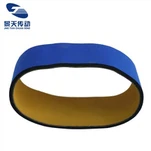
Ordinary conveyor belt: This conveyor belt uses fiber fabric as the core and general rubber as the cover material. The surface is smooth and flat. The core is a layered or overall fabric woven from cotton, nylon, polyester or vinylon fibers. .
Cotton fiber is the earliest used core material, easy to bond with rubber, its strength is slightly improved when wet, but the breaking strength is low, the corrosion resistance is poor, and the application is increasing. The nylon fiber strength is as high as 700N, water resistance, corrosion resistance, and Roundabout fatigue; but the elastic elongation is large, the performance of polyester fiber is similar to nylon fiber, and the elastic elongation is only half of that of nylon fiber when applied. It is a promising material. Vinylon fiber has a strength of 200N and elastic extension. The length is smaller than nylon fiber, it is easy to bond with rubber, and has good heat resistance, but the strength will drop by 10-25% in wet state. When weaving the belt core, only one fiber can be used, or two fibers can be blended or interwoven. Special conveyor belts mainly include steel rope core belts, high-inclination belts, heat-resistant belts, heat-resistant belts, flame-retardant belts, wire mesh belts, steel belts, etc.: High-inclination belts: Contains low pattern belts, high pattern belts, and diaphragms There are several types of flat belts and ribbed belts. The obligatory surface masking rubber of the low-pattern belt has various shapes of rubber bumps or ribs with a height of less than 10 mm to prevent the layer migration of materials and to convey powder And small particles of bulk materials, the height of the bumps on the belt surface of the high-pattern belt is between 10-25 mm to prevent the material from rolling, and is used to convey medium and large-size bulk materials. These two belts can be used to convey The inclination angle is increased by about 10 degrees. The obligatory surface masking glue of the diaphragm type belt has a diaphragm with a height of more than 100 mm. The shape of the diaphragm is divided into double fins, multiple fins, tall V-shaped or in-line shapes. In order to complete the upward conveying with an inclination angle of 53°, the ribbed belt has a transverse baffle with corrugated or plate-shaped ribs. The height of the ribs is 40-300 mm. This belt can complete vertical lifting. Steel cord core belt: Replace the fiber fabric core conveyor belt with a number of special steel cords with good flexibility and high strength. Since the 1960s, steel cord core belts have been widely used. Its breaking strength can be as high as 7000 N/mm, and it is elastically elongated Very small, low lateral stiffness, good impact resistance. Long-distance belt conveyors mostly use this kind of conveyor belt, and they are also used in some belt feeders; Heat-resistant conveyor belt: An industrial conveyor belt with special rubber as a cover material, and the temperature of the conveying material can reach 800 ℃; Cold-resistant conveyor belt: It is also a conveyor belt using special rubber as a cover material, which can be used in an environment of -55°C; Flame-resistant conveyor belt: A rubber belt using polyvinyl chloride or special rubber as a cover material, mainly used in coal mines; It is not easy to produce flames and cause explosions when it has strong friction with the drum or other parts; Steel belt: It is made of cold-rolled steel plate with a thickness of 0.2 to 4 mm, and is mostly used on the conveyor in the drying furnace.