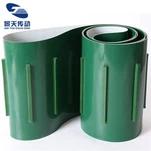
Check key parts
1. Edges: During the operation of the conveyor belt, the edges are prone to friction with the side panels or other parts of the equipment, which is a high-incidence area of wear. Focus on checking whether the edges are worn, deformed, peeled, cracked, etc., especially the edges and corners, where the wear is usually more obvious.
2. Joints: The joints are the weak link of the conveyor belt. After long-term operation, the glue at the joints may age, causing cracking and degumming at the joints, or wear and breakage of the joint sutures. Carefully check the overall appearance of the joints to see if there are gaps, warping or unevenness, and gently press the joints to feel the firmness of the connection.
3. Parts in contact with the roller: This part is one of the areas where the conveyor belt bears the greatest pressure and friction, and is prone to wear, scratches, indentations, etc. During the inspection, observe whether the surface of the conveyor belt in contact with the roller has changed in gloss, darkened in color, thinned in material, etc., and pay special attention to whether there are local wear depressions or wear stripes, which may be caused by uneven roller surface or uneven force.
4. Material carrying area: If the conveyor belt is often loaded with materials, the area where the materials are placed is prone to wear due to friction and collision of the materials. Check whether there are obvious signs of wear and pits in the area, and whether the PVC material on the material contact surface has fallen off or become thinner.
Use inspection method
1. Visual inspection: This is the most basic inspection method. When the conveyor belt stops running and the power is off, carefully observe the surface condition of the above key parts along the length of the conveyor belt to check for abnormal phenomena such as wear, cracks, blistering, discoloration, etc. For some minor wear and tear, it may be necessary to use a strong flashlight to illuminate the surface of the conveyor belt from different angles so that subtle traces can be observed more clearly.
2. Touch inspection: Gently touch the surface of the conveyor belt with your hand to feel its flatness and smoothness. If you find rough, raised or sunken areas, it may be caused by wear. At the same time, some small cracks or peeling that are difficult to detect visually can be checked by touch, and your fingers will have a clear sense of touch when they pass over these parts.
3. Measure the thickness: Use a caliper or a special thickness gauge to regularly measure the thickness of different parts of the conveyor belt, especially the areas that are prone to wear. Compare the original thickness data or the measurement data of different periods to understand the thickness changes of the conveyor belt, so as to judge the degree of wear. If the thickness of a certain area is significantly thinner, it means that the wear of this part is more serious.
4. Operation observation: During the operation of the conveyor belt, observe its operating status. Pay attention to whether there are deviations, jitters, abnormal noises, etc., which may be related to uneven wear or local damage of the conveyor belt. For example, the deviation of the conveyor belt may be due to severe wear on one side of the edge, resulting in uneven force on both sides; jitters or abnormal noises may be due to raised wear parts on the conveyor belt, which vibrate when passing through the drum or roller.