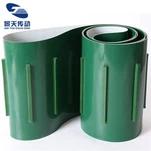
1. Check the appearance:
Surface: Smooth and flat, free of bubbles, grooves, dry spots, and visible marks (depth > 1mm).
Edges: Neat and rounded, free of burrs, cracks, or peeling edges.
Belt core: Uniformly layered, with consistent adhesive thickness.
2. Feel the texture and elasticity:
Material: High-quality rubber belts have a smooth and elastic surface; PVC belts are stiffer, while PU belts are softer and smoother.
Elasticity: Pinch the rubber surface with your fingernail. A high-quality belt (high rubber content) will recover the indentation within 3-5 seconds; a low-quality belt will recover slowly or not at all.
3. Listen to the sound: After applying pressure and releasing, a good elastic belt will immediately return to its original shape with a crisp sound; a low-quality belt will recover slowly or make abnormal noises.
4. Smell the odor: High-quality belts are odorless or have a slight rubber smell; low-quality belts (especially those containing a lot of recycled rubber) have a pungent and acrid odor. Five Core Performance Checks (Professional Testing)
For critical applications, the following tests are required:
Physical Properties: Tensile strength, elongation, abrasion resistance, heat resistance, oil/chemical resistance.
Structural Integrity: Check the core, cover layer, and edge adhesive for firmness and any delamination.