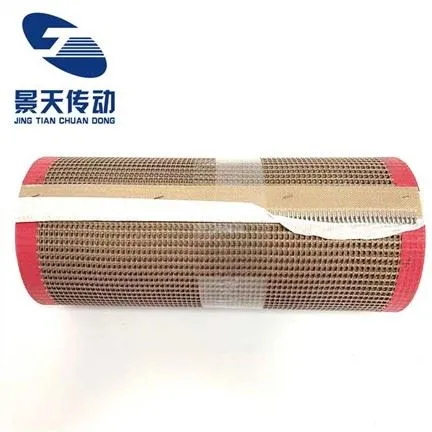
Hey there! As a supplier of silicon conveyor belts, I often get asked if these belts can be used in the textile industry. Well, let's dive right into it and explore this topic.
First off, let's talk about what silicon conveyor belts are. They're made from silicone, a synthetic rubber-like material known for its flexibility, heat resistance, and durability. These belts are used in a wide range of industries, from food processing to electronics manufacturing. But can they cut it in the textile industry?
One of the key requirements in the textile industry is the ability to handle different types of fabrics and materials gently. Silicon conveyor belts are great for this because they have a smooth surface that won't snag or damage delicate fabrics. Whether you're dealing with silk, cotton, or synthetic materials, a silicon conveyor belt can transport them safely and efficiently.
Another important factor is heat resistance. In the textile industry, there are often processes that involve high temperatures, such as drying or ironing. Silicon conveyor belts can withstand these high temperatures without losing their shape or integrity. This means they can be used in continuous production processes without the need for frequent replacements.
Silicon conveyor belts are also resistant to chemicals and oils, which is a big plus in the textile industry. Fabrics are often treated with various chemicals during the manufacturing process, and these chemicals can be harsh on conveyor belts. But silicon belts can handle exposure to these chemicals without deteriorating, ensuring a long service life.
Now, let's compare silicon conveyor belts with some other types of belts commonly used in the textile industry. For example, the Stainless Steel Conveyor Belt Fasteners are known for their strength and durability. However, they can be quite heavy and may not be as gentle on fabrics as silicon belts. On the other hand, the Green Cloth Conveyor Belt is more flexible and may be suitable for lighter applications. But it may not have the same level of heat and chemical resistance as silicon belts.
The Nylon Flat Transmission Belt is another option. It's lightweight and has good transmission properties. But when it comes to handling delicate fabrics and withstanding high temperatures, silicon conveyor belts have an edge.
In terms of maintenance, silicon conveyor belts are relatively easy to take care of. They can be cleaned with mild detergents and water, and they don't require any special lubrication. This reduces the overall maintenance costs and downtime in the production process.
Silicon conveyor belts can also be customized to meet the specific needs of the textile industry. We can offer different widths, lengths, and thicknesses to fit different conveyor systems. We can also add features such as cleats or sidewalls to prevent fabrics from slipping off the belt.
However, like any product, silicon conveyor belts also have some limitations. They may be more expensive than some other types of belts initially. But when you consider their long service life, low maintenance requirements, and the benefits they bring to the production process, the cost can be justified.
In conclusion, silicon conveyor belts can definitely be used in the textile industry. They offer a combination of gentle handling, heat resistance, chemical resistance, and ease of maintenance that make them a great choice for transporting fabrics and materials. If you're in the textile industry and looking for a reliable conveyor belt solution, I highly recommend considering silicon conveyor belts.


If you're interested in learning more about our silicon conveyor belts or would like to discuss your specific requirements, feel free to reach out. We're here to help you find the best conveyor belt solution for your business.
References
- General knowledge about conveyor belts in industrial applications
- Industry reports on the textile manufacturing processes and requirements