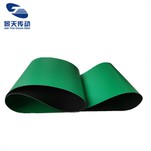
1. Visual Inspection
Cracks and Wear: Inspect the belt surface for longitudinal or transverse cracks, edge wear, or delamination. If the wear depth exceeds 1/3 of the original thickness or a through-crack appears, it must be replaced immediately.
Deformation and Hardening: Hardening, loss of elasticity, or localized bulging (e.g., due to high-temperature aging) of the belt indicate deteriorating material properties.
2. Operational Status Monitoring
Abnormal Noise: A squeaking or metallic friction sound during operation may indicate belt slippage or internal fracture.
Vibration and Tracking: If the conveyor belt vibrates severely (accompanied by a slapping sound) or continuously tracks, and adjustment of the tensioner fails to correct the problem, it requires replacement.
3. Performance Testing
Tension Test: Press the center of the belt; a normal deflection should be approximately 10 mm. If the belt is too loose (slipping) or too tight (increasing bearing strain), it needs to be adjusted or replaced. Load Capacity: If conveying efficiency decreases significantly (e.g., material accumulation, unstable speed), this may be due to belt stretching and deformation.
4. Replacement Criteria for Special Operating Conditions
Corrosive Environments: If the belt surface turns white, swells, or becomes heavily adhered after contact with acids, alkalis, or oils, it may require replacement with a corrosion-resistant model (such as PE).
High-Temperature Environments: Prolonged temperatures exceeding 80°C (80°C) accelerate the aging of PVC/rubber. If the belt becomes brittle or loses its adhesion, a high-temperature-resistant belt should be used.